
In 2024, Lyrasis received grant funding from the ORCID Global Participation Fund to make several improvements to the ORCID Member API functionality in DSpace (version 7.3 and above). The grant project was led by ORCID US Community staff at Lyrasis, in partnership with 4Science and ORCID consortium lead counterparts across the globe.
Over the course of the project, feedback from DSpace community members indicated a need for further improvements related to ORCID and other Persistent Identifiers (PIDs) beyond the scope of the grant. In order to better understand the global DSpace community’s needs related to ORCID and other PIDs in DSpace, ORCID US Community staff conducted a survey from June through October 2025.
The survey received 93 responses, representing 78 organizations in 26 countries. Based on the survey responses, it is clear that:
- Many DSpace community members are already using ORCID and DOIs in their DSpace instance(s).
- Those who are not already using ORCID and DOIs are interested in doing so.
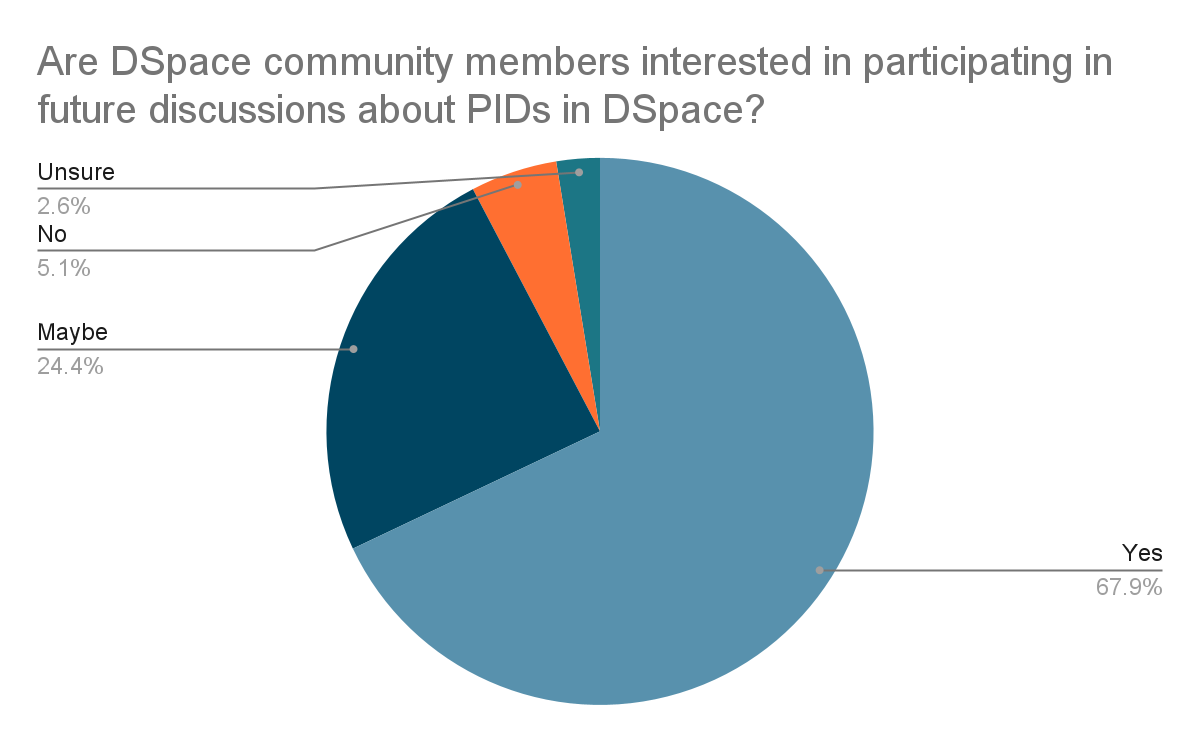
- Respondents share an interest in continued community discussion to help prioritize PID-related functionality improvements and best practices in DSpace, in the interest of making research and scholarship more Findable, Accessible, Interoperable, and Reusable (FAIR) in accordance with the FAIR Principles
Topics for Discussion
The PID-related topics and improvements that DSpace community members have indicated interest in exploring are described below. Given the complexity of these topics, clearly articulated definitions of key terms are available.
General issues:
- Addressing challenges or confusion with existing ORCID functionality and user experience
- Provision of more specific PID-related documentation and support
Functionality enhancements:
Inclusion of an email-based workflow for gathering authors’ authenticated ORCID iDs
- Github Issue 10338
- Not all DSpace instances allow authors to log in, which is currently required for leveraging the ORCID Member API to gather authenticated ORCID iDs for authors. A known solution for this would be to implement an email-based workflow where authors receive an email from the repository prompting them to click an ORCID authentication link to connect their ORCID iD with their work, rather than needing to log in. (This workflow is already being used in OJS and Dryad for example.) Survey responses indicate that the majority of respondents are either interested (41 organizations) or potentially interested (23 organizations) in leveraging this workflow for their own DSpace instance(s) (see Question 7).
Approaches for migrating ORCID iDs from Authority Records to Person Entities
- Github Issue 9530
- A migration path for moving ORCID iDs from Authority Records to Person Entities would only be applicable to organizations that have been storing ORCID iDs with Authority Records and would like to start leveraging Person Entities. Through this survey we have been able to identify the number of organizations that may be interested in exploring this together (see Question 8).
Inclusion of ORCID iDs in other downstream metadata (such as via Open Archives Protocol for Metadata Harvesting [OAI-PMH])
- Github Issue 9529
- DSpace currently does not store authors’ ORCID iDs with work metadata; rather ORCID iDs are stored with author Authority Records or Person Entities. So, special consideration is needed to ensure that ORCID iDs are included when work metadata from DSpace is sent downstream.
- As of November 2025, a code improvement has been merged for inclusion in DSpace 10 (not yet released) that enables ORCID iDs that are stored with Person Entities to be automatically included in DataCite DOI metadata created via the DataCite API integration with DSpace. While this improvement will be available out of the box in DSpace version 10, the code can be implemented in versions 7.x, 8.x, and 9 on a per-instance basis. For organizations using ORCID iDs with Authority Records (rather than Person Entities), additional discussion and work would be needed to ensure inclusion of those ORCID iDs in downstream DataCite DOI metadata.
Inclusion of a Crossref API integration
- Github Issue 9061
- Repositories are increasingly assigning DOIs (Digital Object Identifiers) to local works to support the FAIR principles and comply with funder requirements. While DSpace already has a DataCite API integration available, there is currently no Crossref API integration, and community members have indicated an interest (see Question 6 and Question 10).
Improvements to the DataCite API integration in DSpace
- Several Github Issues have already been submitted indicating a need for improvements to the existing DataCite API integration, with the majority of survey respondents either assigning or interested in assigning DataCite DOI to repository works. Streamlined functionality for DOIs could benefit many (see Question 6).
Potential improvements to the ROR integration in DSpace
- ROR (Research Organization Registry) is an open PID for organizations that is already available in DSpace, but community members have indicated interest in improvements (see Github Issues).
Additional improvements to the ORCID-related functionality in DSpace, such as:
- Improvements to ORCID sync queue (Github Issue 4533)
- Add ability to re-send works to ORCID (Github Issue 11004)
- Improve handling of discarded items in ORCID sync queue (Github Issue 10832)
- Include new work types in ORCID sync (Github Issue 11003)
- Improve the way Person Entities work with names (Github Issue 10585)
- Improve handling of long character names (Github Issue 9951)
- Improve experience of searching for an ORCID iD (Github Issue 10776)
- Add ORCID branding to ORCID log-in button (Github Issue 5175)
- Provide explanation of the benefits of ORCID (Github Issue 5166)
- ORCID iDs should be displayed to ORCID’s guidelines (Github Issue 4656)
- Use data from ORCID records to populate researcher profiles (Github Issue 5147)
- Allow administrators to configure settings for importing ORCID data (Github Issue 11985)
Other potential topics for organizations that are not using Person Entities and are not planning to, but still want to leverage PID best practices in DSpace, include:
- Approaches for gathering, storing, and displaying authors’ authenticated ORCID iDs if Person Entities are not being used
- Automatic inclusion of ORCID iDs in DataCite DOI metadata if Person Entities are not being used
- Solutions for displaying ORCID iDs next to author names on work landing pages if Person Entities are not being used
Additional Resources
To explore the full summary of survey responses, please see the DSpace, ORCID, and PIDs Survey Results Summary (2025). For questions or comments related to this survey and potential next steps, please contact orcidus@lyrasis.org.